

It followed me throughout my business career, long before I ever spoke about identity, consciousness, or transformation. At the time, I was working with established businesses, entrepreneurs, coaches, and startups, helping them develop strategies to grow. Together, we would build plans that made sense. They weren't imposed on anyone. They were created with them. They were practical, commercially sound, and aligned with what they wanted to achieve.
And yet something refused to make sense.
Some entrepreneurs never implemented the strategy, even though they genuinely wanted the results. Others started enthusiastically but stopped somewhere along the way. Some did everything they had planned and still failed to create the outcome that, on paper, should have been possible.
I found myself asking the same question over and over again.
The question became more personal when I noticed the same in my own business.
At one stage, I was teaching businesses how to generate clients through Facebook advertising and sales funnels. A few of my clients were using the very systems I had developed, yet they were acquiring leads for a fraction of what I was paying. In some cases, my cost per lead was ten times higher than theirs. They were spending a small percentage of what I was spending, keeping the profits inside their businesses while a significant part of mine seemed to disappear into advertising costs.
It made no logical sense. I knew the strategy.
At the time, I didn't have an answer. I only had a question that was bringing a lot of frustration.
Years later, after my own life began changing in ways I could never have anticipated, I started observing something within myself that I had never noticed before. As my awareness deepened, I could see recurring structures beneath my thoughts, emotions and behaviours. They felt older than my habits and deeper than my beliefs. They seemed to organise the way I experienced life itself.
The next question was obvious: “Was this simply my own experience, or was it something universal?”
I had no interest in creating another theory. If these structures existed only in me, they were interesting. If they existed in everyone, they represented something entirely different.
So I began observing.
Gradually, a remarkable pattern emerged.
The same fundamental structures appeared again and again, regardless of age, profession, culture or background. What changed was not the Seed itself, but the way it expressed itself through each individual.
Each Seed had a structure, and the structure was different in each person. This became one of the most important discoveries of my work.
For most of my life, conflict seemed to follow me everywhere. Looking back, I could see that I had argued with friends, colleagues, business partners and people I cared about. From my perspective, the conflicts felt justified. I believed I was standing for truth, fairness or principle. From the perspective of many people around me, however, I simply created unnecessary battles.
Over the years I worked deeply on myself. The obvious expressions of conflict became softer. I believed I had finally moved beyond it. There had not been any conflict in my life for over a year.
Then one ordinary morning showed me that I had not yet reached the root.
I was staying at my partner's house while my own home was being rented through Airbnb. When I switched on my phone, I found dozens of messages in our street WhatsApp group. One neighbour had written a harsh message complaining that I rented my house to "every dog" who didn't know how to park. My guests had blocked part of the street and one neighbour couldn't get their car out.
I immediately apologised and contacted my guests so they could move the car. The practical problem was solved within minutes.
The story could have ended there. Instead, a few hours later, another thought appeared: "I'm not going to let them get away with this."
I remembered photographs I had taken months earlier showing those complaining neighbours parking badly themselves. I posted them in the group to prove that they were behaving no differently.
The conflict immediately escalated. People stopped talking about the parking and started questioning why I had taken the photographs in the first place. The conversation became bigger than the original event.
Later that day, I sat quietly reflecting on what had happened. One question kept returning: “How had I managed to create conflict when I wasn't even there?”
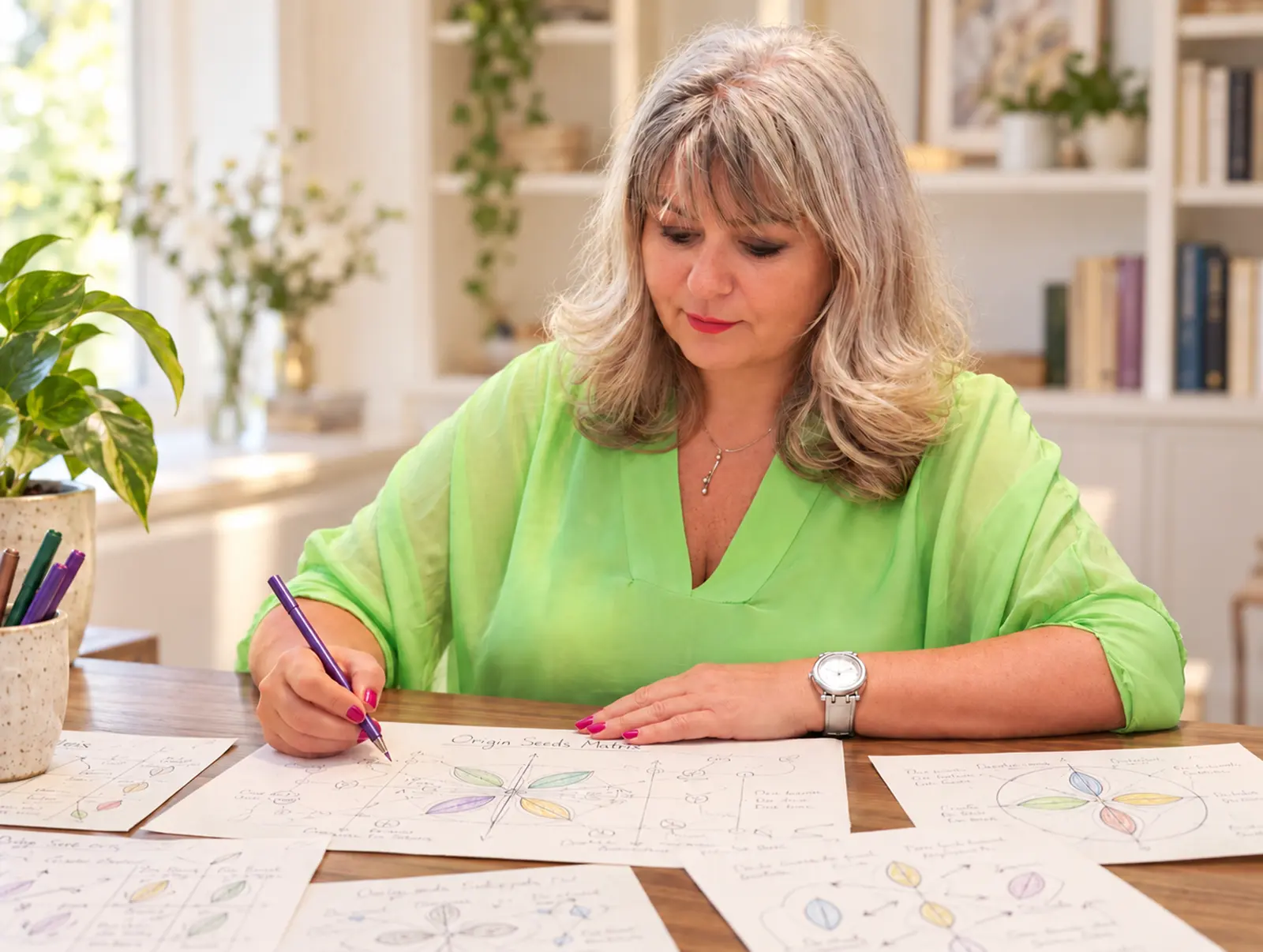
That was the moment I saw something I had never recognised before. One of the hidden expressions of my Conflict Seed was not simply the need to prove, defend or be right. It was the satisfaction I unconsciously experienced through conflict itself. Not consciously, and never deliberately. But somewhere within the architecture, conflict created a feeling of completion.
Once I saw it, decades of my life suddenly made sense. The arguments. The relationships that ended. The moments when proving something became more important than peace.
The architecture had been expressing itself through countless situations, each one different on the surface but organised by the same invisible Seed beneath.
This is why I no longer see behaviour as the starting point. Behaviour is only the visible expression. The architecture is where the story begins.
Every Origin Seed™ can express itself in countless different ways. One person with the Conflict Seed may seek confrontation at every opportunity. Another may avoid conflict completely, becoming silent, shrinking themselves, or saying yes when they mean no. A third may appear balanced in most areas of life but repeatedly experience conflict in intimate relationships or at work.
What changes is the architecture through which that Seed organises a person's experience.
Once I understood this, I also understood why people cannot be placed into categories. People are not categories. They have architectures.
And it is only by seeing that architecture that we can begin to understand not only why people think, feel and behave as they do, but also how profound and lasting transformation becomes possible.
After years of observing the Origin Seeds™, another pattern gradually became impossible to ignore: Every Seed had two expressions.
The first was the one people usually recognised. It was the survival expression. This was the version that shaped the fears, emotional reactions, recurring behaviours and life experiences people wanted to change. It was the identity the Seed had constructed in order to protect them.
But that was only half of the story. Hidden within every Origin Seed™ was another expression altogether.
Over time, I stopped asking myself how to remove a Seed. That had been my initial goal because I believed the Seed itself was creating the problems in my life.
The goal became understanding how to allow the survival expression to dissolve so that the gift already held within the same Seed could naturally emerge.
This completely changed the way I understood transformation. I no longer saw people as broken. I saw them as organised around gifts that had become hidden beneath structures that once kept them safe.
Perhaps this is the most hopeful discovery of all. The opposite of a survival pattern is not emptiness. It is the gift that has been waiting beneath it, which also means something profoundly important: No one is condemned to live through the survival expression of their Origin Seeds™ forever.
The architecture can change. And when it does, the same Seed that once organised fear, struggle or limitation begins expressing itself through entirely different qualities. This is the work of the Precision Identity ReCode™ Method.
It is not about fighting the Seed, suppressing it or becoming someone else. It is about recoding the invisible architecture through which the Seed has been expressed, allowing its original gift to become the organising principle of your life.